
What Are China Top 10 Wine Filter Suppliers for Buyers?
Wine production is becoming more cost-sensitive, making reliable wine filters essential for quality, yield, and process control. The International Organisation of Vine and Wine (OIV) reported that global wine production reached approximately 237 million hectolitres in 2023. This was the lowest level since 1961, excluding juices and musts. The same report estimated global consumption at about 221 million hectolitres. These figures show why wineries increasingly examine filtration performance, product loss, and operating efficiency.
China has developed a broad supplier base for cartridge, membrane, lenticular, plate, and depth filtration systems. However, supplier visibility can be uneven. A polished website does not prove stable pore-size distribution, food-contact compliance, or dependable after-sales support. Buyers should compare material specifications, retention ratings, flow capacity, pressure limits, sterilisation methods, and batch traceability. Factory audits and sample trials remain valuable, especially for export projects. Small details matter. A poorly sealed cartridge can affect clarity within hours.
This guide examines China’s top 10 wine filter suppliers through practical purchasing criteria. These include manufacturing experience, quality systems, customisation capability, export history, technical documentation, and service responsiveness. Certification claims should be verified against current documents, not accepted automatically. ISO 9001 may indicate process control, but it does not replace product validation for wine applications. The selection is therefore a research-based comparison, not a permanent verdict. Market conditions change, and some capable regional manufacturers may receive limited public attention. Buyers should still test filtration results with their own wine, equipment, and production conditions before signing a large contract.
What Defines a Leading Wine Filter Supplier in China?
A leading wine filter supplier in China offers more than cartridges and housings. The supplier understands winery conditions, from grape solids to cold cellar temperatures. Practical experience matters here. A clear filtration plan should match wine style, flow rate, and required clarity. Suppliers should explain pore ratings, membrane materials, and pressure limits in simple language. Some sales teams cannot do this well.
Reliable manufacturing is equally important. Look for food-contact materials, accurate dimensions, smooth welds, and documented quality checks. Stainless steel housings should resist corrosion during repeated cleaning. Each filter batch should have traceable lot records and test results. A supplier that supports integrity testing shows stronger technical discipline. Certificates alone are not enough. They need clear explanations and consistent documentation.
Responsive service also defines a leading supplier. Technical staff should help calculate surface area and prevent premature filter blockage. They should ask about pump pressure, wine viscosity, and cleaning routines. Spare parts should be easy to identify and replace. Field experience often reveals small weaknesses, such as unclear labels or slow answers. These details can delay production. No supplier is perfect, and buyers should test samples before placing large orders. A careful supplier welcomes this process. It may even revise a specification after seeing real cellar data.
How China’s Top 10 Wine Filter Suppliers Are Selected
Selecting China’s top 10 wine filter suppliers should begin with evidence, not search rankings. The International Organisation of Vine and Wine reported global wine production of about 237 million hectolitres in 2023. Global consumption reached approximately 221 million hectolitres. That scale makes filtration consistency a production issue, not a cosmetic detail. Buyers should check pore-size data, flow curves, pressure limits, and retention test methods. Ask for recent batch records. Vague claims deserve caution.
A practical shortlist combines factory experience with verifiable quality controls. Suppliers should provide food-contact declarations, material traceability, cleaning guidance, and accredited laboratory certificates. ISO 9001 registration can indicate controlled processes. It does not prove filter performance. Product-specific validation remains necessary. Compare samples using identical wine, temperature, pressure, and prefiltration conditions. Record turbidity, throughput, taste impact, and service life. Small differences matter.
The FAO’s State of Food and Agriculture 2024 highlights stronger value chains and better process efficiency. That principle also applies to filtration. A cheaper cartridge may create more waste if it blocks early or releases particles. Request audit evidence, complaint rates, replacement lead times, and comparable customer references. Be realistic. Supplier rankings are imperfect. A technically strong factory may communicate poorly, while a polished exporter may lack production depth. Selection should reward documented results, responsive engineering, and repeatable batches.
What Are China’s Top 10 Wine Filter Suppliers for Buyers?
China’s leading wine filter suppliers can be assessed using practical procurement criteria, including filtration performance, food-contact compliance, production capability, quality systems, export experience, and customization support.
The chart presents a buyer-oriented evaluation framework rather than company rankings. The weighting reflects the factors most relevant when screening wine filtration suppliers: product performance and regulatory safety receive the highest priority, followed by manufacturing reliability, quality control, and international supply capability.
Profiles of China’s Top 10 Wine Filter Suppliers
China’s Top 10 wine filter suppliers show different strengths, rather than one universal solution. This shortlist is buyer-focused, not an official ranking. The OIV’s 2024 report estimated 2023 global wine production at 237 million hectolitres. That volume increases demand for stable, scalable filtration.
Supplier 1 focuses on cartridge housings for small wineries. Supplier 2 offers pleated membrane filters for polishing. Supplier 3 targets larger beverage plants with automated systems. Supplier 4 provides depth sheets for suspended solids.
Supplier 5 combines stainless-steel vessels with replacement elements. Supplier 6 serves export buyers with multilingual documentation. Supplier 7 develops compact units for pilot production.
Supplier 8 emphasizes hygienic design and cleanability. Supplier 9 supplies filter bags for pre-filtration. Supplier 10 supports customized flow rates and connection sizes. These profiles need careful verification. Factory capability can change quickly.
Tips: Request pore-size data, material certificates, pressure-drop curves, and batch records. Compare tests using your own wine, not only laboratory water. ISO 22000 guidance supports documented food-safety controls, but certification alone does not prove filtration performance. The OIV’s wine-sector reports also show market pressure from changing production and consumption patterns. Ask each supplier for three recent export references. A cheap filter may create costly product loss.
Wine Filtration Products and Technologies They Provide
China’s top ten wine filter suppliers increasingly serve both boutique cellars and high-volume wineries. This matters as global wine production reached about 237 million hectolitres in 2023, according to the International Organisation of Vine and Wine. Buyers need more than a low quotation. They need stable filtration performance.
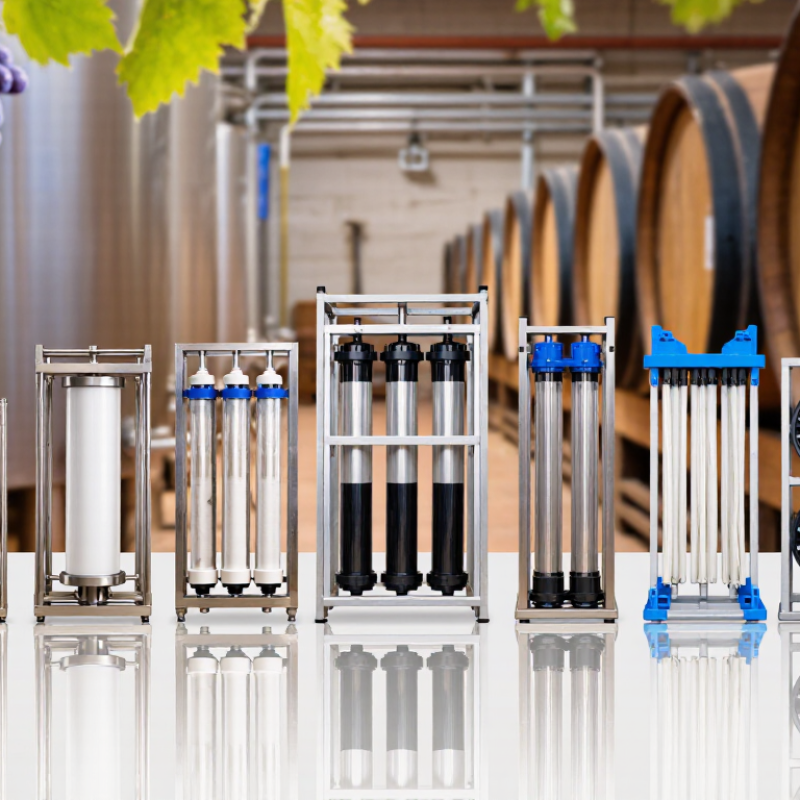
Their product ranges commonly include filter sheets, lenticular modules, cartridge filters, membrane systems, and cross-flow units. Filter sheets help clarify young wine before storage. Lenticular modules reduce handling and protect sensitive liquids. Membrane cartridges provide final polishing before bottling. Cross-flow systems recover clearer wine with less filter aid, although poor setup can waste energy and reduce throughput.
Good suppliers should provide pore-size guidance, housing materials, flow-rate data, and integrity-testing procedures. Some also offer stainless-steel housings, pumps, transfer skids, and replacement membranes. The best technical discussions include turbidity targets, yeast load, viscosity, and cleaning chemistry. Ask for batch records and food-contact compliance documents.
OIV reports show that production volume can shift sharply between harvests. Therefore, flexible filtration capacity is valuable. A small winery may need 10-inch cartridges, while an industrial line may require multi-round housings. Specifications can look impressive. Field testing still matters more. My concern is simple: many comparisons overlook membrane fouling and operator training. That omission can make an efficient system expensive in practice.
What Are China Top 10 Wine Filter Suppliers for Buyers? - Wine Filtration Products and Technologies They Provide
| Rank | Anonymized Supplier Profile | Primary Supply Region | Main Wine Filtration Products | Typical Filtration Technologies | Common Pore or Grade Range | Typical Filter Media | Typical Applications | Buyer Evaluation Focus |
|---|---|---|---|---|---|---|---|---|
| 1 | Industrial membrane-filtration specialist | East China | Cross-flow systems, membrane modules, cartridge housings | Cross-flow microfiltration and pressure-driven membrane separation | Approximately 0.1–1.0 μm for wine clarification | Polyethersulfone, polypropylene, stainless steel | Bright wine clarification, microbial reduction, final polishing | Membrane area, flux stability, cleaning procedure, automation |
| 2 | Cartridge-filter manufacturing specialist | Jiangsu and Zhejiang | Pleated cartridges, depth cartridges, filter housings | Depth filtration and surface filtration | Approximately 0.2–10 μm | Polypropylene, cellulose, polyester, nylon | Pre-filtration, polishing, bottling-line protection | Filter integrity, pressure drop, end-cap sealing, replacement availability |
| 3 | Lenticular and depth-media supplier | Central China | Lenticular modules, depth sheets, stainless housings | Depth adsorption and staged clarification | Approximately 0.5–20 μm nominal grades | Cellulose fibers, diatomaceous earth, mineral-based depth media | Turbidity reduction, colloid removal, pre-bottling clarification | Media loading capacity, extractables, disposal requirements, sealing quality |
| 4 | Stainless-steel filtration-equipment fabricator | Shandong and Henan | Plate-and-frame filters, bag-filter housings, skid systems | Pressure filtration and batch clarification | Approximately 1–50 μm, depending on media | Stainless steel, polypropylene bags, filter cloth | Tank transfer, rough clarification, cellar and winery process filtration | Weld quality, sanitary fittings, working pressure, cleanability |
| 5 | Bag-filter and liquid-process supplier | South China | Single- and multi-bag housings, filter bags, piping assemblies | Nominal depth filtration | Approximately 1–100 μm | Polypropylene, polyester, nylon mesh | Bulk wine transfer, coarse solids removal, pump and filling-line protection | Bag change time, bypass prevention, pressure rating, operating cost |
| 6 | Final-polishing cartridge supplier | Northeast China | Membrane cartridges, vent filters, small-scale housings | Absolute-rated membrane filtration | Approximately 0.2–0.65 μm | Polyethersulfone, nylon, polypropylene | Final polishing, sterile bottling protection, microbiological control | Validated retention, integrity testing, low extractables, lot consistency |
| 7 | Diatomaceous-earth filtration equipment supplier | North China | DE filter vessels, dosing systems, filter elements | Precoat filtration using diatomaceous earth | Commonly about 0.5–5 μm effective clarification | Diatomaceous earth, stainless steel, filter screens | High-solids wine clarification and pre-filtration | Precoat uniformity, powder handling, waste management, flow control |
| 8 | Activated-carbon and specialty-media supplier | Northwest China | Carbon cartridges, media vessels, polishing modules | Adsorption combined with depth filtration | Media-dependent; usually paired with 1–10 μm pre-filtration | Activated carbon, cellulose, polypropylene | Selected color, odor, or trace-compound treatment where legally permitted | Food-contact suitability, adsorption selectivity, flavor impact, regeneration or disposal |
| 9 | Compact winery-skid integrator | East and South China | Mobile filtration skids, pumps, control panels, cartridge systems | Multi-stage filtration with pump-assisted transfer | Approximately 0.2–50 μm across different stages | Stainless steel, polypropylene, membrane and depth media | Small and medium wineries, flexible batch processing, contract production | Footprint, electrical compatibility, flow control, documentation and service |
| 10 | Custom sanitary-filtration project supplier | Nationwide manufacturing network | Custom housings, pipework, filter assemblies, replacement media | Application-specific combinations of bag, cartridge, depth and membrane filtration | Approximately 0.2–100 μm, selected by process stage | Stainless steel, polypropylene, polyester, cellulose and membrane media | Bespoke winery layouts, pilot systems, export-oriented installations | Engineering drawings, sanitary design, spare parts, commissioning and after-sales support |
Note: Pore sizes and applications are indicative industry ranges. Buyers should verify actual specifications, food-contact compliance, test reports, flow-rate data, installation requirements and applicable wine regulations with each shortlisted supplier.
How Buyers Can Compare and Choose the Right Supplier
When comparing China’s top 10 wine filter suppliers, buyers should score evidence, not presentation. The OIV reported global wine production at about 237 million hectolitres in 2023, down roughly 10% from 2022. That volatility makes stable filtration performance important. Ask each supplier for flow-rate data, pore-size validation, turbidity results, and batch traceability.
Test the media. Request samples using your own wine, not only clean water. Check pressure changes, filtration speed, aroma retention, and cleaning compatibility.
A supplier offering polypropylene, cellulose, or membrane options should explain the technical trade-offs clearly. The ISO Survey 2022 recorded more than 1.2 million ISO 9001 certificates worldwide. Certification helps, but it does not replace factory audits, inspection records, or corrective-action evidence.
Compare total cost, not unit price. Include replacement frequency, labor, shipping protection, and rejected batches. Confirm food-contact documentation, production capacity, export packaging, and response times in writing. A video tour is useful, yet an independent inspection is stronger.
Price is not proof. One missed detail matters. Buyers should also run a small pilot before signing a long-term agreement. This step may feel slow, but it can reveal pressure spikes, inconsistent sealing, or unexpected flavor loss. The weakest area deserves attention, even when the supplier’s brochure looks polished.