7 Tips for Choosing the Best Foldable Golf Umbrella
Golf weather can shift quickly, even when the morning forecast looks calm. A sudden shower can leave a golfer juggling a bag, clubs, and a dripping canopy. A Foldable Golf Umbrella is useful when it opens quickly, offers practical coverage, and packs away without fuss. Still, compact size alone does not make a good choice. A narrow canopy may protect one player but leave a golf bag exposed. A heavy frame can feel tiring over a long round. Small details matter. The grip, opening mechanism, fabric, and folded length all shape everyday use. No model is perfect.
These seven tips explore the features worth checking before you buy. They cover canopy size, frame construction, wind handling, ease of opening, grip comfort, weight, and storage. Product descriptions can be helpful, but measurements and warranty details offer more concrete points of comparison. If possible, check how the umbrella feels when folded and how easily its canopy opens. A claimed wind rating may not reflect every course condition. That deserves a second look. The aim is not to find a flawless umbrella, but one that suits your usual weather, walking distance, and golf bag. A little extra weight may be acceptable for wider coverage; a bulky design may not be. Use these practical checks to choose with more confidence and fewer surprises on the course.
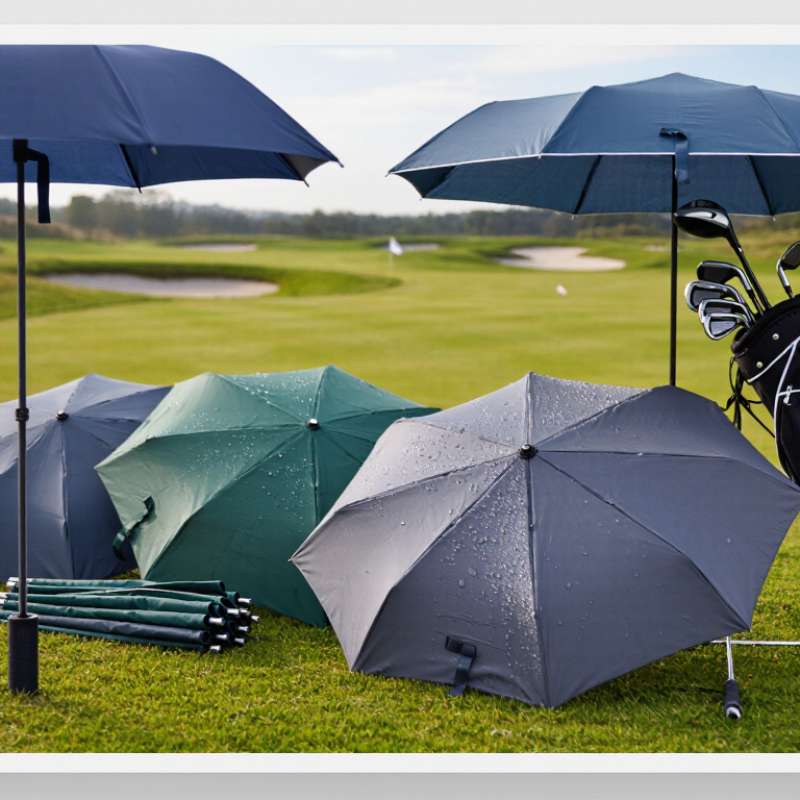
Compare Canopy Span: 60–68 Inches Is Common for Golf Umbrellas
A 60–68-inch canopy spans five feet to five feet eight inches, a common range in golf-umbrella product specifications. It can shelter a golfer and part of a bag, but the number needs context. Check whether the stated span measures the canopy’s widest point or its curved fabric; those are not identical. Measure it yourself. Open the umbrella and compare its edge with your shoulder width, then picture it beside a golf bag. A broad canopy feels useful on an exposed fairway, but awkward between trees or in a crowded cart.
There is no universal golf-umbrella span set by the USGA. Rule 4.3 of the 2023 Rules of Golf addresses permitted equipment, not canopy dimensions, so treat 60–68 inches as a common market range, not an official standard. ISO 811:2018 measures fabric resistance to water penetration; it does not rate how much space an umbrella covers. That distinction matters. A larger canopy may shelter more, yet it can also catch more wind. I’d weigh span against frame stability and how easily the folded umbrella fits in your bag. A little inconvenient to check, but worthwhile.
Check Folded Length and Weight Against Your Golf-Bag Storage Space
Tip 1: Measure the space first. Check the golf bag’s umbrella sleeve or side pocket, including its opening and usable depth. Compare those measurements with the umbrella’s folded length, not its open canopy size. A few centimeters can matter when clubs and grips crowd the top. Measure twice if the pocket is tapered.
Tip 2: Check weight alongside length. A compact umbrella can still feel awkward if it is heavy, especially when carried for several holes. Look at the listed weight, then consider what else is already in your bag. Water, balls, and a rangefinder add up. It is easy to overlook that.
Tip 3: Try the fit before your first round. Slide the folded umbrella into its intended pocket and see whether it catches on club shafts or blocks access to other gear. If possible, test it with the bag loaded. That gives a more realistic picture. Measurements help, but pockets can be oddly shaped, and product details may not capture that. A little extra room is useful; a tight fit can turn a quick rain check into a small hassle.
7 Tips for Choosing the Best Foldable Golf Umbrella - Check Folded Length and Weight Against Your Golf-Bag Storage Space
| Tip | What to Check | Practical Guide | Why It Matters |
|---|---|---|---|
| 1. Measure your bag’s storage space | Measure the usable length and width of the umbrella sleeve or pocket, including any opening restrictions. | Choose an umbrella that is shorter than the compartment’s usable length, leaving a little clearance for easy removal. | Advertised folded length may not account for a narrow pocket opening or bulky handle. |
| 2. Compare folded length carefully | Check the manufacturer’s stated length when fully closed, from handle end to tip. | Compact folding models are often around 12–15 in (30–38 cm); larger golf umbrellas commonly fold to about 15–18 in (38–46 cm). | A few extra inches can determine whether the umbrella fits inside your bag or needs to be carried externally. |
| 3. Check the weight, not just the size | Look for the umbrella’s listed weight and consider how much extra weight you are willing to carry. | Many full-size golf umbrellas weigh roughly 1–1.5 lb (0.45–0.68 kg), though frame materials and construction can change this. | A lighter umbrella is easier to carry, while a sturdier frame may add weight. |
| 4. Balance coverage with packability | Compare the open canopy size with the umbrella’s closed length and weight. | Golf umbrellas often have a canopy arc of about 60–68 in (152–173 cm); larger canopies generally take up more space and can catch more wind. | The right balance depends on whether you prioritize coverage, compact storage, or low carrying weight. |
| 5. Inspect the folding mechanism | Confirm whether it opens and closes manually or automatically, and check the number of folding sections. | More folding sections can reduce packed length, but the folded bundle may be thicker than a simpler design. | A compact length does not guarantee that the folded umbrella will fit a slim bag pocket. |
| 6. Look for a wind-conscious frame | Review the frame material, rib construction, and whether the canopy includes wind vents. | Fiberglass ribs are commonly used for flexibility; vented canopies are designed to let some wind pass through. | These features may help in gusts, but no umbrella should be treated as storm-proof. |
| 7. Check the packed shape and carry options | Check the closed diameter, handle shape, sleeve, and any strap or clip. | If bag storage is tight, compare both folded length and the thickest point of the closed umbrella. | A tapered or bulky handle can make an otherwise suitable umbrella awkward to store or retrieve. |
Size and weight figures are general shopping benchmarks, not specifications for a particular umbrella. Always check the product’s listed measurements before buying.
Assess Rain Protection Using AATCC TM22’s 0–100 Spray Test
7 Tips for Choosing the Best Foldable Golf Umbrella
A high spray rating can help compare canopy fabrics, but it is not a complete umbrella score. AATCC TM22, the American Association of Textile Chemists and Colorists’ spray test, rates surface wetting from 0 to 100. In the method, 250 mL of water is sprayed onto a fabric specimen, then its wetting pattern is matched to the rating scale. A 100 indicates no sticking or wetting; a 90 allows slight, random wetting. That difference matters when rain beads on a canopy instead of leaving dark patches. Ask for the test method and result, not just “water-repellent” wording. Small detail. But useful.
I still find this score easy to over-trust. TM22 assesses surface wetting, not leakage through seams, zipper areas, or stitch holes, and it does not measure wind performance. For a foldable golf umbrella, check whether the tested fabric came from the actual canopy and whether seams were evaluated separately. ASTM D751, a standard for coated fabrics, includes tests related to water resistance; its results answer different questions from TM22. A strong spray rating is a good sign, not a promise of dry sleeves in driving rain. I would compare it alongside canopy coverage, frame stability, and how securely the umbrella locks open. The numbers help, but the whole umbrella still deserves a closer look.
Choose UV Coverage by UPF Rating: 50+ Blocks at Least 98% of UV
When comparing foldable golf umbrellas, check the canopy’s UPF rating rather than relying on color or thickness alone. UPF 50+ means the tested fabric blocks at least 98% of ultraviolet radiation. In other words, no more than about 2% passes through the fabric under test conditions. A high rating helps, but it is not a force field.
On a sunny fairway, the sun’s angle shifts as you walk between shots. Choose a canopy wide enough to shade your head, neck, and shoulders while you hold it comfortably. Read the product details to confirm the UPF rating applies to the canopy fabric. Small detail, big difference. A compact umbrella may fold neatly into a golf bag, yet leave your arms exposed when opened.
Shade also depends on how you use the umbrella. UV can reach uncovered skin from the sides, and bright surfaces may reflect some sunlight upward. Keep exposed areas protected with suitable clothing or sunscreen. Check the fabric for wear, stretching, or damage, and follow its care instructions; a worn canopy may not perform like new. I might choose the highest rating available, but I would still consider coverage and handling. One is easier to compare on paper.
Inspect Frame Design and Look for Verifiable Wind-Test Data
When comparing foldable golf umbrellas, inspect the frame before judging the canopy. Open and close it several times. Watch whether the runner catches, ribs twist, or joints feel loose. A higher rib count alone does not prove greater strength; rib shape, joint quality, and how the frame spreads gust pressure also matter. Small details show up quickly in your hands.
Ask for wind-test results, not just claims such as “storm resistant.” A useful report identifies wind speed, test duration, sample count, and whether the umbrella was tested open, angled, or repeatedly cycled. The World Meteorological Organization’s Beaufort scale describes Force 6 winds as 22–27 knots, when using an umbrella becomes difficult. That is useful context, not a pass mark for a product. Test conditions differ, and one laboratory result cannot guarantee performance in every gust.
Look closely at the hinge pins and rib ends. Do they flex smoothly, or scrape and buckle? Check whether the handle and shaft remain aligned after repeated opening. I would prefer clear test records over a dramatic maximum-speed number; that number can hide short test times or unusual setups. And honestly, a compact umbrella is still a compromise: lighter frames may feel less reassuring in sustained wind. Ask how the data was measured, and keep the answer with your purchase notes.