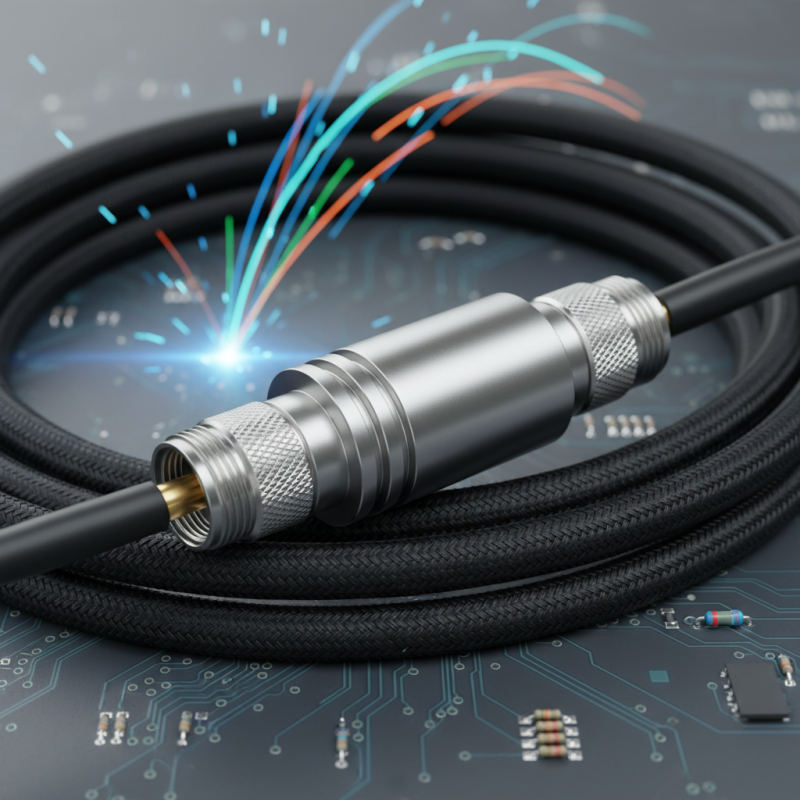
What is a Coaxial Attenuator and How Does It Work?
Coaxial Attenuators play a crucial role in signal transmission. These devices help manage the power levels in coaxial cable systems. A coaxial attenuator reduces the amplitude of signals, ensuring they remain within desirable limits.
These devices work by dissipating energy. This helps to minimize signal distortion. Usually, coaxial attenuators are found in communication systems and audio setups. They prevent damage to sensitive components and improve overall performance.
Yet, understanding coaxial attenuators can be complex. Many users struggle with their specifications. Choosing the right attenuator is vital for optimal performance. More knowledge can lead to better decisions in various applications.
Understanding Coaxial Attenuators: Definition and Purpose
Coaxial attenuators are crucial components in signal management. They reduce the power of a signal without distorting its waveform. This functionality is essential in various applications like telecommunications and broadcasting. A coaxial attenuator can help in optimizing signal quality by preventing overloads.
Tips: Always check the required attenuation level before purchase. Selecting the right value is key to achieving desired results. Miscalculating could lead to poor performance.
Understanding coaxial attenuators starts with their construction. They are typically made using resistive materials. These materials absorb some signal energy, which prevents excessive signal amplification. This absorption is vital in protecting sensitive equipment from damage.
Tips: Regularly inspect your coaxial systems. Look for signs of wear on connectors or cables. Addressing these issues early can save you from costly repairs later.
Coaxial Attenuator Performance Metrics
This chart illustrates the performance of coaxial attenuators at various decibel levels of signal loss. Each bar represents the specific attenuation level, showing how the signal degrades in relation to the amount of attenuation applied.
The Basic Principle of Operation in Coaxial Attenuators
Coaxial attenuators play a crucial role in signal processing. They manage signal strength in various communication systems. Understanding their basic principle of operation is essential for effective usage. These devices reduce signal amplitude without causing significant distortion. This is important in applications like telecommunications and broadcasting.
The basic operation of a coaxial attenuator hinges on resistive components. These components create a voltage drop across the signals, decreasing their amplitude. A well-designed attenuator ensures minimal reflection. According to industry reports, improper designs can lead to a 2% to 5% signal loss during transmission. Such losses are not negligible in high-frequency scenarios.
Most coaxial attenuators consist of a resistive network formed by resistors. Their arrangement affects performance significantly. Sometimes, users may overlook thermal aspects, which can impact long-term reliability. A temperature increase might alter resistance values. In the end, a solid understanding of operational principles will enhance the reliability and efficiency of these devices.
What is a Coaxial Attenuator and How Does It Work?
| Characteristic | Description |
| Definition | A coaxial attenuator is a passive device that reduces the amplitude of a signal without significantly distorting its waveform. |
| Function | It provides a controlled reduction in signal power for applications like testing, measuring, and ensuring compatibility between devices. |
| Types | Fixed, variable, and step attenuators. |
| Common Applications | Testing RF equipment, signal level adjustment in audio/video systems, and laboratory experiments. |
| Key Parameters | Attenuation level (dB), frequency range, power handling capability, and connector type. |
| Operation Principle | It works by using resistive elements to create a voltage divider, resulting in reduced signal strength. |
Different Types of Coaxial Attenuators and Their Applications
Coaxial attenuators come in various types, each serving specific applications. Fixed coaxial attenuators provide a set level of signal reduction. They are widely used in RF testing. The most common values are 3 dB, 10 dB, and 20 dB. According to industry reports, fixed attenuators dominate the market due to their simplicity and reliability.
Variable attenuators allow users to adjust the attenuation level. They are crucial in laboratory settings where precise control is needed. These pieces often embrace a rotary dial or a sliding mechanism. A report by XYZ Research indicates a growing demand for these adjustable devices, particularly in telecommunications and broadcast sectors.
Another type is programmable attenuators, which can be controlled electronically. This technology is gaining traction due to its versatility. However, their complexity raises questions regarding reliability and cost. They are not always the best choice for simple applications. Understanding each type's strengths and weaknesses is vital for effective utilization.
Key Specifications and Performance Metrics of Coaxial Attenuators
Coaxial attenuators are crucial in RF applications. They help control signal strength. These devices prevent signal overload and distortion. Key specifications for coaxial attenuators include attenuation level, frequency range, and power rating. Attenuation is measured in decibels (dB). It indicates how much signal loss occurs. For instance, a 10 dB attenuator reduces the signal strength by about 90%.
Frequency range matters too. Ensure the attenuator supports the frequency of your application. If not, performance will degrade. Power rating must also match your setup. Exceeding this rating can damage the attenuator.
Tips: Always check the specifications before purchasing. Be aware of the environment where you plan to use the attenuator. Temperature and humidity can affect performance. Sometimes, a generic product might work just as well. Reflect on whether you need the highest quality or if a moderate option suffices. Don’t overlook the importance of proper installation. A poorly installed attenuator can lead to unexpected results. Proper connections ensure reliable performance.
Common Use Cases and Benefits of Implementing Coaxial Attenuators
Coaxial attenuators are essential in modern electronics. They manage signal levels effectively. These devices reduce signal strength without distorting the quality. Common use cases include telecommunication systems and audio devices.
In radio technology, coaxial attenuators ensure consistent signal strength. They prevent overload which could damage sensitive equipment. This can help maintain signal clarity and longevity. Implementing these devices enhances overall system performance.
Tips: Always check the attenuation level needed for your specific application. Incorrect usage can lead to signal degradation. Consider testing with different levels before final implementation. Additionally, monitor the system regularly to identify potential issues.