What Are the Top Anchor Chain Types in 2026?
Choosing an Anchor Chain is not a cosmetic decision. It affects how an anchor holds, how loads travel through the system, and how crews inspect wear. UNCTAD’s Review of Maritime Transport 2024 notes that more than 80% of world trade by volume is carried by sea. That scale helps explain why dependable anchoring equipment matters across commercial fleets, offshore operations, and smaller vessels. But the report does not compare chain designs; that distinction matters.
This guide examines the leading chain types expected to remain relevant in 2026, including stud-link and studless designs, alongside differences in grade, material, and intended service. ISO 1704:2021 provides requirements for stud-link anchor chains, while classification-society rules add vessel-specific context. These references help frame a practical comparison, but they cannot replace checking the vessel’s approved equipment specifications. A chain that looks robust on a dock may still be unsuitable for a particular windlass or anchoring system. Details matter.
The sections ahead will compare strength, handling, corrosion considerations, inspection needs, and typical applications. They will also clarify where product labels can mislead: “stronger” does not automatically mean “better.” Real operating conditions, compatible fittings, and maintenance history all count. No single chain type wins every time. Some trade-offs remain, and buyers should verify claims against certified product documentation rather than relying on marketing language alone.
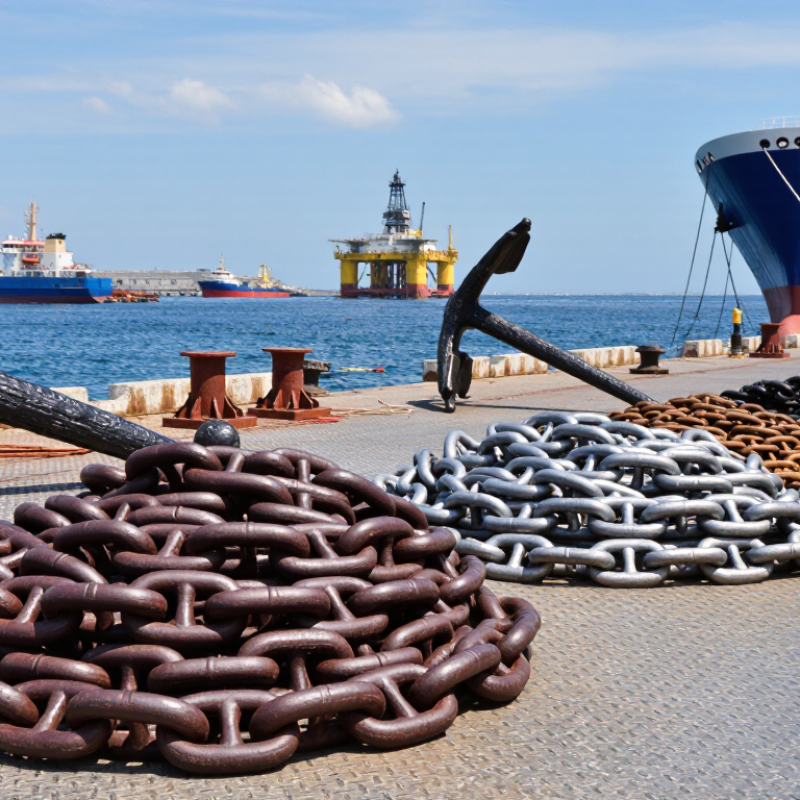
What an Anchor Chain Is and How It Functions
An anchor chain connects the anchor to the vessel and carries load through each steel link. As it pays out, the chain’s weight forms a curve called a catenary. That curve can soften sudden pulls and keep the pull angle low at the anchor. In shallow water or strong conditions, much of the chain may lift from the seabed. The cushioning effect then decreases. The anchor itself still provides the seabed grip.
Stud-link chain has a crossbar inside each link, helping resist deformation and tangling. It is common on larger vessels and heavy-duty anchoring systems. Studless chain has no crossbar and can be lighter, but its suitability depends on the load and equipment. Short-link and long-link describe link proportions; not every windlass accepts both. Check the chain’s grade, diameter, working load, and windlass compatibility before choosing. Numbers on a specification sheet do not tell the whole story.
In practical use, fit matters. A chain that jams in the gypsy can interrupt a controlled anchor drop. Rinse salt and grit from links, then inspect for rust, cracks, and stretched sections. Look closely near the bitter end and high-wear points. Small details count. I would not judge chain condition by appearance alone; a clean link can still be worn. Have doubtful chain assessed against the vessel’s requirements.
The Main Anchor Chain Types Used in 2026
Anchor chains in 2026 are commonly distinguished by link shape, construction, and material. Short-link chain has compact links and often runs smoothly through a compatible windlass gypsy. Long-link chain uses longer links and can be lighter per length, but may not fit some windlasses. Check chain markings and equipment specifications; appearance alone can mislead.
Stud-link chain has a crosspiece, or stud, across each link. It helps limit deformation and tangling under heavy loads, making this style common on larger vessels and moorings. Studless chain lacks the crosspiece and is easier to handle and stow. It can suit smaller boats, though strength and windlass compatibility still matter. Small details matter.
Galvanized steel is common because its zinc coating helps protect the chain at a manageable cost. Stainless steel resists surface corrosion, but can still suffer crevice corrosion, especially where links rub or remain wet. Some boats use a mixed rode, with chain near the anchor and rope farther along. There is no universal best type. Match grade, diameter, length, and calibration to the vessel, anchor, seabed, and windlass manual. I would verify the fit before buying; a chain label does not tell the whole story.
How Anchor Chain Materials and Grades Differ
What Are the Top Anchor Chain Types in 2026?
Material and grade affect an anchor chain’s strength, corrosion resistance, weight, and upkeep. Galvanized carbon steel is a common choice because its zinc coating helps slow rust. Inspect links for worn coating, especially near the bow roller, where repeated contact can expose the steel. Stainless steel resists corrosion well, but it can still stain or pit in harsh marine conditions. It may also cost more. No chain is maintenance-free.
Grade describes a chain’s strength classification, but labels and standards can vary. A higher grade generally offers greater strength for a given link size; it does not automatically make every chain suitable for every windlass or anchor. Match the chain’s specified grade and diameter to the windlass manual and the anchor system’s working loads. Check the markings and confirm that connecting hardware is compatible. This detail is easy to miss. It matters.
Tips: Rinse salt from the chain after use, and inspect links for cracks, distortion, or deep corrosion. If markings are unreadable, don’t guess—verify the chain’s specifications before relying on it.
Key Factors for Comparing Anchor Chain Types
Comparing anchor chain types starts with the windlass, not the catalogue. Short-link chain usually runs smoothly through a matching gypsy, while long-link chain may jam or climb poorly. Check the chain’s diameter and pitch against the windlass manual. Fit matters. A chain that looks right on deck can still fail to feed cleanly.
Stud-link chain has crosspieces inside each link, helping reduce tangling and deformation under heavy loads. It is common on larger vessels, but its bulk and weight may be excessive for a small boat. Studless chain is simpler in shape and can be easier to handle, though its suitability depends on the rated load and equipment. Compare working-load guidance, not just breaking strength. Those figures are not interchangeable.
Material and use matter, too. Galvanized steel is a practical choice for many boats, but inspect for worn coating, stiff links, and deep rust, especially near the anchor shackle. Stainless steel resists surface corrosion, yet crevice damage can be hard to spot. Chain weight can help the anchor settle, but it also adds bow load. A spec sheet can still hide a poor fit. Confirm compatibility with the gypsy, connector, and intended vessel, then inspect the actual chain before use.
Choosing an Anchor Chain for a Vessel’s Needs
Choosing an anchor chain starts with the vessel, not a catalog label. Displacement, bow-roller clearance, windlass capacity, and expected anchoring conditions all matter. Short-link calibrated chain suits many windlasses because its links fit the gypsy reliably. Check the windlass manual before buying; matching diameter alone is not enough. A chain that skips under load can damage equipment and complicate retrieval.
Hot-dip galvanized steel is a common choice for its balance of strength, cost, and corrosion protection. It needs inspection: look for worn links, flaking coating, and rust near the bitter end. Stainless steel resists corrosion, but it costs more and still needs care, especially where oxygen-poor crevices encourage corrosion. Stud-link chain is often used on larger vessels, while long-link chain may not fit standard windlasses. Weight matters. More chain can improve catenary, but it also adds load to the bow.
Match the chain’s grade and working-load limits to the vessel and anchor system, using the equipment maker’s specifications or a qualified marine professional. Consider water depth, bottom type, wind, and current when setting rode length; chain alone cannot compensate for poor scope. A practical check is to lay out several links and inspect them for distortion, stiff joints, or uneven wear. I would not choose by diameter alone. There is no universal winner.
What Are the Top Anchor Chain Types in 2026? - Choosing an Anchor Chain for a Vessel’s Needs
| Chain Type | Construction or Category | Typical Vessel Use | Key Advantages | Selection Considerations |
|---|---|---|---|---|
| Stud-link chain | Each link has a crossbar, or stud, across its center. Commonly supplied in calibrated sizes for windlasses. | Commercial ships, larger vessels, and many offshore applications. | The stud helps the link retain its shape under load and reduces the risk of link deformation. Widely used in vessel anchoring systems. | Confirm the chain diameter, grade, certification, and calibration match the windlass and the vessel’s equipment requirements. |
| Studless chain | Links have no crossbar. Strength, weight, and dimensions depend on the specified standard and chain grade. | Selected marine mooring systems and applications where a studless design is specified. | A simpler link form can be useful where the system is designed around studless chain. | Do not assume it is interchangeable with stud-link chain. Check the required breaking load, connection hardware, and windlass compatibility. |
| Short-link calibrated chain | Shorter links made to specified dimensions; calibrated versions are intended to engage compatible windlass gypsies. | Small craft and yachts equipped with a chain windlass. | Designed for consistent engagement with a matching gypsy and commonly used in anchor rodes. | Standards and dimensions vary. Match the chain to the gypsy specification rather than relying on nominal diameter alone. |
| Long-link chain | Uses longer links than short-link chain and is generally supplied for applications that do not require a short-link windlass profile. | Some small-vessel anchor rodes or general-purpose marine uses without a chain gypsy. | Can be suitable for simple systems where the chain is handled without a windlass gypsy. | Often will not run correctly through a short-link chain gypsy. Verify handling equipment and rated capacity before use. |
| High-strength chain | A strength category, not a link shape. Available in different configurations and grades; designations depend on the applicable standard. | Vessels needing a specified strength-to-weight performance, when permitted by the equipment design. | May provide a higher rated strength for a given chain size compared with lower-strength options, depending on the grade and standard. | Check the exact grade, proof and breaking-load data, certification, and windlass approval. A higher-strength chain is not automatically compatible with existing equipment. |
| Stainless-steel chain | Chain made from corrosion-resistant stainless steel; link form and mechanical properties vary by product and specification. | Some smaller vessels and applications where appearance or corrosion resistance is a priority. | Can offer good resistance to corrosion in suitable marine conditions. | Corrosion resistance does not determine strength. Verify alloy, rated load, inspection requirements, and compatibility with the anchor system; stainless chain may cost more than galvanized alternatives. |
Selection note: Chain type, link size, grade, and calibration are separate specifications. Before purchase, compare the vessel’s design requirements with the chain certificate, windlass gypsy, connectors, and applicable maritime rules. Inspect the chain regularly for wear, corrosion, deformation, and damaged links.