What Are the Top Concert Lighting Types in 2026?

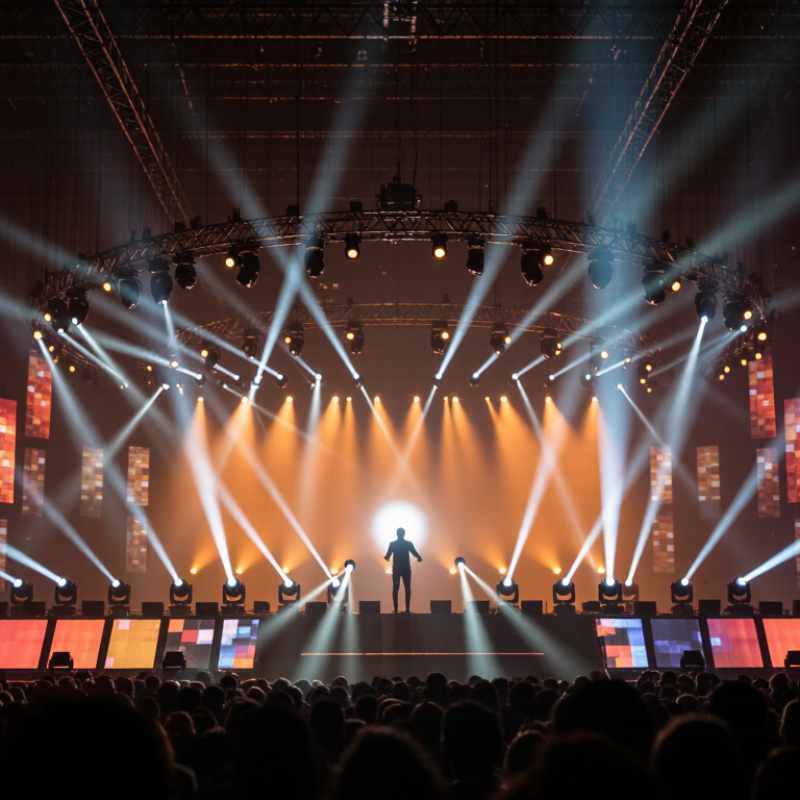
Concert Lighting in 2026 is about shaping attention, not simply filling a stage with bright color. Audiences may notice a sharp beam cutting through haze, a warm wash across a singer’s face, or a sudden burst of white light at a chorus. Each effect serves a different purpose. Moving-head fixtures create changing positions and patterns, while LED wash lights provide broad, even color. Beam lights add narrow shafts; strobes create brief flashes; and followspots keep a performer visible as they move. Pixel-mapped bars and panels can turn stage surfaces into animated patterns. More light is not better.

The most effective setup depends on the room, the music, and the view from the audience. A compact club may need flexible fixtures and careful control of glare. A large arena may call for longer throws, layered beams, and coordinated looks across the stage. Camera exposure, fixture placement, power, haze, and sightlines also shape what works in practice. Even a dramatic effect can feel distracting when it obscures performers or repeats without purpose. That is easy to overlook. This guide compares the leading concert lighting types for 2026, explains where each fits, and highlights practical factors for choosing a balanced rig. Equipment capabilities and show needs vary, so treat any trend as a starting point—not a substitute for testing the design in the actual venue.
What Are the Top Concert Lighting Types in 2026?

LED Wash and Pixel Fixtures: 512 DMX Slots per ANSI E1.11 Universe

A concert lighting rig in 2026 often pairs broad LED wash fixtures with pixel-addressable effects. Wash units paint performers and scenery with even color; pixel fixtures create moving patterns across individual emitters. The key limit is control capacity.

ANSI E1.11, the ESTA/USITT DMX512-A standard, defines 512 data slots in one DMX universe. A slot carries one 8-bit value, typically controlling a parameter such as dimmer level, pan, or color.

That number is easy to misread. A fixture using 30 DMX channels takes 30 slots, so one universe can address at most 17 such fixtures, with two slots left. Pixel fixtures may use far more channels when each LED cell is controlled separately.

Check the fixture’s channel mode and patch sheet before programming; a compact-looking bar can consume a universe quickly. A simple wash may need fewer slots, but its exact footprint still depends on its selected mode.

ESTA’s ANSI E1.11 documentation is the authoritative reference for DMX512-A’s data structure. For larger pixel rigs, lighting teams commonly distribute control across multiple universes using networked DMX protocols.

Keep the plan practical. It is tempting to maximize every slot, but spare capacity can make last-minute changes less painful. And yes, patching still deserves a second look.

Moving Heads: 16-Bit Pan/Tilt Enables 65,536 Positions per Axis

A 16-bit pan/tilt system offers 65,536 control values per axis, from 0 to 65,535. That is a finer digital address grid than 8-bit control, which provides 256 values. ESTA’s ANSI E1.11-2008 (R2018), the DMX512-A standard, defines DMX data slots as 8-bit values; fixtures commonly combine coarse and fine channels to create 16-bit movement control. On a moving head, this can help produce smoother slow pans, more precise beam placement, and fewer visible jumps during gradual cues. The difference shows most clearly on long throws or when a narrow beam must land near a performer’s mark.

The number needs context. More values do not guarantee 65,536 mechanically distinct positions: motor behavior, fixture calibration, optics, and control settings all affect what the audience sees. That matters. A carefully programmed 8-bit move can look clean, while a poorly tuned 16-bit move may still jitter. In rehearsal, test slow movement across the actual stage, especially at the ends of travel. Watch the beam on scenery, not only on the console display. The fine channel can also make troubleshooting less intuitive, since a tiny value change may cause a barely perceptible shift. Useful precision, but not magic.

Moving Head Pan/Tilt Resolution: Position Values per Axis

Comparing the number of digital position values available at different bit depths.

A 16-bit value represents 65,536 possible digital positions per axis (216). These are control values, not a guarantee of physical movement accuracy; actual performance depends on the fixture’s mechanics and design.

Followspots and Profile Fixtures: Compare Illuminance in Lux at Set Distances

Followspots and profile fixtures can produce very different lux readings at the same throw distance. A followspot usually concentrates light into a tight beam. A profile fixture shapes a pool or image, and shutters or gobos may reduce usable output. For an illustrative center-beam comparison, assume measured intensities of 500,000 candela for a followspot and 125,000 candela for a profile fixture. Using the inverse-square relationship described in the IES Lighting Handbook, estimated illuminance is 5,000 versus 1,250 lux at 10 meters, 1,250 versus 313 lux at 20 meters, and 556 versus 139 lux at 30 meters. Distance changes everything.

These figures are calculations, not market averages or product guarantees. The IES method assumes a point source and clear measurement conditions; real fixtures have beam spread, optical losses, and uneven fields. CIE 121:1996, The Photometry and Goniophotometry of Luminaires, describes how luminaire intensity is measured. For a fair comparison, check each fixture’s photometric report and compare center-beam lux at the same distance, zoom, and focus. A handheld meter should face the incoming beam at the performer’s position. Small differences in aiming can change the reading. That matters. Also note whether a report lists peak lux or an average across the beam; the two figures answer different stage-planning questions.

Strobes and Effects: Assess Flicker Risks Using IEC 62471 Guidance

What Are the Top Concert Lighting Types in 2026?

Strobes and moving effects can make a concert feel immediate and intense. A rapid white flash across a dark stage is memorable, but it can also trigger discomfort or photosensitive reactions in some viewers. Risk depends on more than flash rate. Brightness, pulse duration, contrast, viewing distance, and repeated exposure all matter. One setting rarely suits every room.

IEC 62471 provides guidance for evaluating photobiological hazards from lamps and lamp systems, including certain retinal and ultraviolet risks. It is not a flicker-safety rating, and it does not establish that a strobe effect is safe for every audience. A qualified lighting or safety professional can assess the source’s spectral output and exposure conditions under the standard, then review temporal effects separately. That distinction is easy to miss. Keep test records, and reassess when fixtures, angles, or show cues change.

Tips: Preview effects from several audience positions, including near the stage and at the rear. Avoid prolonged, tightly repeated flashes, and offer clear warnings before performances. Keep strobes away from direct sightlines where practical. If someone reports symptoms, stop the effect and review the cue rather than assuming the setting is harmless. Safety planning is imperfect, but careful testing makes it more informed.

Concert Lasers: Apply IEC 60825-1 Classification and Exposure Limits

Concert lasers can make a venue feel larger, but their narrow beams need careful control. IEC 60825-1 classifies laser products according to accessible radiation under defined conditions. Classification is not cosmetic. A class label does not, by itself, confirm that a particular show setup is safe for every audience position.

Class 1, 2, 3R, 3B, and 4 indicate increasing hazard potential, with exact classification determined by the product and applicable test conditions. Many high-power show systems fall into higher classes, but assumptions are risky. Exposure limits depend on factors such as wavelength, pulse pattern, beam size, and exposure duration. A single output figure cannot settle the question. Small errors matter.

For a concert, a qualified laser safety professional should assess the equipment, room layout, audience sightlines, and operating conditions. Keep beams out of audience eye level, and use appropriate beam stops, access controls, and emergency procedures. Check for reflective surfaces, too; a polished truss can send light somewhere unexpected. Visual checks help, but they cannot replace proper measurement. Even a well-planned show can miss a detail, so review the setup whenever conditions change.

What Are the Top Concert Lighting Types in 2026? — Concert Lasers: Apply IEC 60825-1 Classification and Exposure Limits

Concert laser effects are defined by how the light is used; their IEC 60825-1 class is determined by accessible laser emission and test conditions, not by the effect name alone.

Concert laser type Typical visual effect Classification considerations Exposure and operating controls
Scanning beam effects Moving beams, fans, tunnels, and aerial patterns created by rapidly steered laser light. The product class depends on accessible emission under the applicable IEC test conditions. A moving scan does not, by itself, establish a safe class. Assess audience-accessible exposure, including a credible stationary-beam or scan-failure condition. Keep beams out of audience-accessible areas unless the exposure assessment and applicable rules permit them.
Laser graphics and projection Text, logos, geometric patterns, or animated images projected onto a screen or other surface. Projection onto a surface does not determine the laser class. Consider direct and reflected accessible emission, along with wavelength, pulse characteristics, and viewing conditions. Aim at a suitable projection surface and prevent direct viewing of the beam. Evaluate potential specular reflections from shiny surfaces and equipment.
Aerial beam arrays Multiple visible beams arranged as parallel lines, a fan, or a layered stage effect. The number of beams or fixtures does not indicate a class. Evaluate each accessible emission and consider overlapping or combined exposures where relevant. Set beam paths and audience boundaries deliberately. Verify exposure at accessible positions, including balconies, elevated platforms, and other foreseeable viewing locations.
Beam-and-haze effects Haze makes the path of a laser beam visible through the venue air. Visible beam paths in haze do not show whether an exposure is within a limit. Classification and exposure assessment require the laser’s emission characteristics and the applicable measurement conditions. Do not use apparent brightness or visibility in haze as a safety measure. Control beam access and assess exposure independently of the visual effect.
Audience-directed effects Beams or patterns designed to pass over or appear within the audience area. Audience access requires a specific assessment against the applicable exposure limits and venue rules; a product class alone does not establish that audience exposure is acceptable. Use only where permitted and supported by a documented assessment of accessible exposure. Apply suitable operating procedures, trained supervision, and safeguards against unexpected beam movement or scan failure.

IEC 60825-1 laser class reference — simplified visible continuous-wave examples

IEC class General description Important interpretation
Class 1 Accessible emission is within the Class 1 accessible emission limits under the specified classification conditions. The limits depend on wavelength, duration, and other test conditions. Some products contain higher-powered sources that are enclosed during normal use.
Class 1M / 2M Classes for certain beams that can present an additional hazard when viewed with optical instruments. Do not assume that binoculars, telescopes, or other optical aids are safe for viewing these beams.
Class 2 Visible lasers (400–700 nm); for a continuous-wave beam under the applicable classification conditions, the Class 2 accessible emission limit is 1 mW. The classification relies on the specified conditions, including the assumed aversion response. Do not deliberately stare into the beam.
Class 3R A reduced-risk class. For visible continuous-wave emissions under applicable conditions, the limit is up to 5 mW. Direct viewing can be hazardous. The 5 mW figure is a simplified visible continuous-wave reference, not a universal limit for every wavelength or pulse format.
Class 3B Direct beam viewing is hazardous. For visible continuous-wave emissions under applicable conditions, this class is generally above the Class 3R range and up to 0.5 W. Diffuse reflections are generally less hazardous than direct exposure, but risk depends on the circumstances. Follow the product instructions and applicable safety procedures.
Class 4 Exceeds the Class 3B accessible emission limits; for visible continuous-wave emissions under applicable conditions, this generally means above 0.5 W. Direct and reflected beams can cause serious eye or skin injury; fire and material hazards may also apply.

Exposure-limit note: IEC laser class and maximum permissible exposure (MPE) are different concepts. MPE assessment depends on factors such as wavelength, exposure duration, pulse structure, beam dimensions, and viewing geometry. Determine exposure using the applicable IEC 60825-1 methods and relevant local regulations; the simplified class examples above are not a substitute for classification, measurement, or a venue-specific safety assessment.