Top Sieve Components Manufacturers in China?
Choosing a Sieve Components manufacturer in China takes more than comparing catalog prices. Buyers need to examine mesh accuracy, frame materials, weld consistency, and the fit between each component and the screening machine. A small mismatch can cause rattling, uneven separation, or premature wear. Details matter.
W. Edwards Deming, a respected quality-management expert, is often quoted as saying, “Quality comes not from inspection, but from improvement of the production process.” Deming was not a sieve specialist, but the principle applies: reliable components depend on repeatable manufacturing, not just a final check. This guide looks at how Chinese manufacturers approach those practical demands, from wire mesh and perforated plates to screen frames and tensioning parts. It also considers material options, customization, production capacity, and the clarity of technical documentation. Ask for sample data. Check the tolerances.
A polished product photo cannot confirm aperture consistency or edge finish. Request specifications, inspection records, and clear answers about replacement parts. When possible, compare samples under the same operating conditions. No supplier is perfect, and published claims may leave questions unanswered. That deserves attention. The following overview is designed to help buyers assess manufacturers with care, identify useful questions, and shortlist suppliers whose capabilities match their application.
What Are Sieve Components and Where Are They Used?
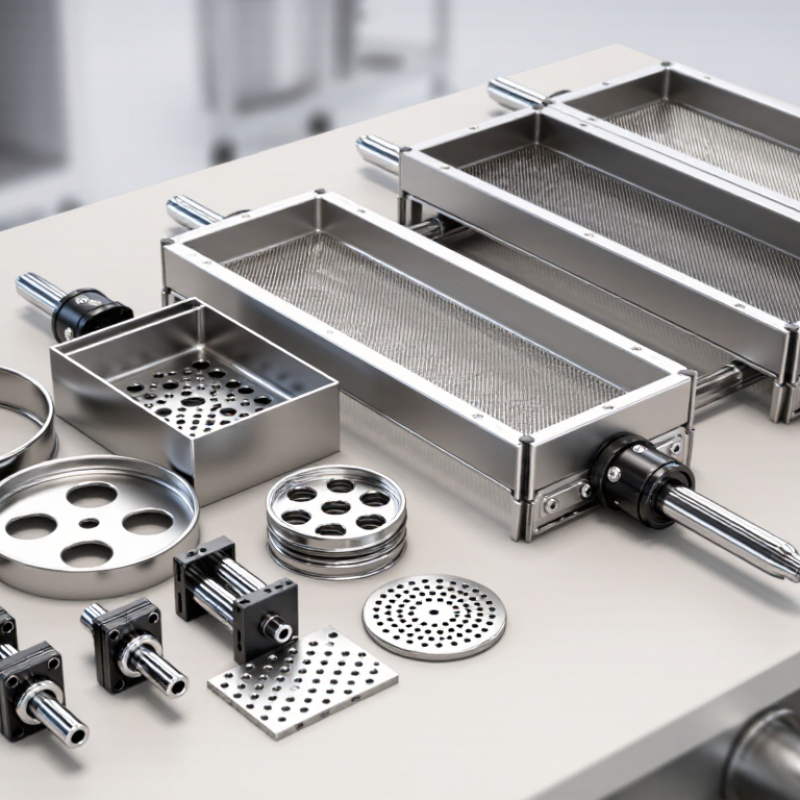
Sieve components are the parts that separate particles by size. A typical assembly uses woven wire mesh or perforated plate, a supporting frame, tensioning rings, clamps, and seals. Mesh opening size determines which particles pass through; frame stiffness and even tension help prevent sagging, tearing, or uneven separation. Small parts matter. In practice, seals can be overlooked, yet a poor fit may let material bypass the screen.
These components are used in grain cleaning, food and chemical processing, and mineral screening. FAO’s Food Outlook (June 2024) forecast global cereal production at 2.854 billion tonnes for 2024, illustrating the scale of material that may require cleaning and grading. In its Mineral Commodity Summaries 2025, the U.S. Geological Survey estimated U.S. crushed-stone output at about 1.5 billion tons in 2024; screening separates aggregate into usable size ranges. Selection depends on particle shape, moisture, throughput, and cleaning needs. A fine mesh may improve separation but can blind when damp material builds up. That trade-off is not always obvious from a specification sheet. Check the aperture, wire thickness, frame fit, and operating conditions together.
Which Sieve Components Are Commonly Made in China?
Chinese suppliers commonly manufacture woven wire mesh, perforated screens, screen frames, tensioning rings, clamps, and replacement gaskets. Mesh openings may range from coarse, visible grids to fine screens used for powder classification. Buyers often specify wire diameter, aperture, weave, and stainless-steel grade. A small mismatch can reduce throughput or let unwanted particles pass. Details matter.
The material supply base is substantial. worldstainless’ Stainless Steel in Figures 2024 reports that China produced about 36.7 million tonnes of stainless steel in 2023, out of 58.4 million tonnes worldwide. This does not measure sieve-component output, but it helps explain the broad availability of stainless mesh and fabricated frames.
Common options include stainless steel, carbon steel, and, for some applications, polyurethane or rubber screen panels. Check the intended material against moisture, abrasion, and cleaning conditions.
Manufacturers also make supporting parts: ball-tray cleaners, seals, springs, and quick-release clamps. These can look interchangeable, yet dimensions and hardness affect fit and service life. Ask for aperture checks, frame measurements, and material certificates where consistency matters. Not every supplier documents these equally well. That remains a practical weakness. A sample test with the actual feed can reveal blinding, edge leakage, or unexpected wear before a full order.
How Are Sieve Components Manufactured and Quality-Tested?
Sieve components are made through a sequence of controlled cutting, forming, joining, and finishing steps. Manufacturers select mesh and frame materials for the intended load, product contact, and cleaning conditions. Mesh is cut to size, tensioned, and secured to a frame or support ring. Welds and edges need close attention; a tiny burr can trap residue or damage the screen. Small details matter. Surface finishing follows, with care taken to avoid distorting the mesh.
Quality checks begin with dimensions, frame flatness, and mesh opening size. Calibrated optical tools can reveal uneven openings that are hard to spot by eye. Technicians may also check mesh tension, weld integrity, and surface condition. A clean-looking joint is not proof of strength, so inspection methods should match the component’s design and use. Records linking measurements to production batches help trace defects. Still, sampling can miss a local flaw; that deserves honest review.
Tips: Ask for the mesh specification, inspection results, and batch records. Check edges under good light, and confirm the component fits its sieve assembly without forcing it.
Common Standard Test-Sieve Apertures
These selected nominal aperture sizes are part of the preferred series in ISO 565. For wire-cloth test sieves, ISO 3310-1 specifies requirements and test methods. During quality control, manufacturers check mesh apertures and inspect the cloth, frame, and joints; the applicable tolerances depend on the sieve specification.
What Types of Sieve Component Manufacturers Operate in China?
China’s sieve-component suppliers generally fall into four groups. Woven-wire makers produce stainless-steel mesh for fine sizing and laboratory screens. Perforated-plate shops punch thicker steel sheets for coarse, abrasive feed. Polyurethane and rubber processors mold modular panels that reduce impact and noise. Wedge-wire fabricators form slotted surfaces for drainage and dewatering. Some workshops also cut, weld, and finish complete screen decks to customer drawings.
The distinction matters on a plant floor. A mesh panel may suit dry, fine material, while a molded panel can better tolerate repeated impact.
Fit matters. ISO 9044:2016 sets requirements and test methods for industrial woven-wire cloth, including aperture tolerances. It offers buyers a useful benchmark, but it does not certify every finished sieve assembly.
Fortune Business Insights estimated the global screening-equipment market at USD 6.77 billion in 2023; that figure covers equipment, not sieve components alone. It suggests broad demand, not a guaranteed market size for Chinese parts.
Some suppliers combine several processes, so the categories overlap. That can make comparisons less tidy than a product catalogue suggests. Ask for aperture checks, material certificates, and a sample panel tested against the actual feed.
How Can Buyers Evaluate Chinese Sieve Component Suppliers?
When evaluating Chinese sieve component suppliers, start with the operating conditions, not the catalogue. Share the material being screened, target particle size, moisture level, and expected throughput. Ask for the screen’s aperture tolerance, wire diameter, open area, and frame dimensions. These details affect separation and fit. For perforated plates, confirm hole shape, spacing, and sheet thickness. Request material certificates and inspection records, then compare them with the specification. A supplier’s stated tolerance is useful, but a measured sample is better evidence.
Tips: Ask for a sample from the same process used for production. Check aperture consistency with a suitable gauge, inspect welds and edges, and confirm that the component sits flush in your equipment. Keep the approved drawing and sample reference on file.
Review quality controls and communication before placing a large order. Ask how the supplier tracks materials, handles rejected parts, and reports dimensional checks. A clear answer should include records, not just assurances. Also verify production capacity and lead time against your schedule. A polished catalogue cannot show whether a frame will warp during use. I would test samples under real operating conditions where possible; that step takes time, but skipping it can be costly. Even a careful evaluation cannot remove every risk, so document agreed tolerances and acceptance criteria before production.
Top Sieve Components Manufacturers in China? - How Can Buyers Evaluate Chinese Sieve Component Suppliers?
| Evaluation Dimension | What Buyers Should Verify | Useful Evidence or Test | Suggested Weight |
|---|---|---|---|
| Product and application fit | Confirm the component type, dimensions, aperture, wire diameter, screen profile, and operating conditions match the intended machine and material. | Approved drawings, dimensional inspection report, and a sample checked against the machine interface and process requirements. | 20% |
| Material specification and traceability | Check that the specified metal, polymer, or other material grade is suitable for the application, including corrosion, temperature, and wear requirements. | Material certificates where applicable, purchase-lot traceability, and documented material identification. | 15% |
| Quality control and consistency | Review how the supplier controls critical dimensions, aperture uniformity, welds or joints, surface finish, and defects across production lots. | Inspection plan, calibrated measurement equipment records, lot inspection results, and an agreed defect-acceptance standard. | 15% |
| Manufacturing capability | Assess whether the supplier has suitable processes and capacity for the required component design, order quantity, and repeat-order schedule. | Process descriptions, production-capacity details, equipment list, and a pilot order or production sample. | 10% |
| Customization and engineering support | Determine whether the supplier can work from buyer drawings or samples and manage revisions without ambiguity. | Drawing review, written tolerance confirmation, revision-controlled documents, and a documented change-approval process. | 10% |
| Testing and documentation | Confirm that inspection and test records cover the characteristics important to the component and its application. | Sample inspection reports, test methods, certificates requested in the purchase specification, and records linked to the supplied lot. | 10% |
| Lead time and delivery reliability | Check quoted production time, raw-material availability, order scheduling, and the supplier’s process for communicating delays. | Written lead-time commitment, delivery schedule, and order-status update procedure. | 5% |
| Export packaging and shipping readiness | Ensure packaging protects the components from moisture, impact, deformation, and contamination during handling and transit. | Packaging specification, packing-list format, and confirmation of shipping marks and export documents required for the order. | 5% |
| Commercial terms and total cost | Compare quotations on the same technical scope, order quantity, tooling needs, packaging, payment terms, and delivery basis. | Itemized quotation and written confirmation of inclusions, exclusions, tooling charges, and any minimum order quantity. | 5% |
| After-sales and corrective action | Review how the supplier handles nonconforming goods, replacement requests, root-cause analysis, and corrective actions. | Written claim procedure, response-time expectations, and sample corrective-action records with sensitive details removed. | 5% |
| Total suggested evaluation weight | 100% | ||
This is a buyer evaluation framework, not a supplier ranking. Confirm specifications and acceptance criteria against the actual application, drawings, and purchase contract.